One of the first responsibilities of any leader is to create clarity. Role clarity in leadership helps people understand what is expected of them, what they are responsible for and how their work contributes to the wider team. When people have this clarity, they are more likely to perform well, make better decisions and experience greater wellbeing at work.
When people understand what is expected of them, what they are responsible for and how their work contributes to the wider team, they are much more likely to perform well and experience greater wellbeing at work.
Research consistently shows that role clarity is one of the strongest predictors of employee performance and wellbeing. Conversely, role ambiguity is associated with increased stress, burnout, poorer performance and higher staff turnover.
Despite this, role clarity is often overlooked when people first move into leadership positions. Leaders are frequently promoted because of their technical expertise rather than their leadership capability and creating shared clarity around expectations is one of the conversations that can easily be missed.
What is role clarity?
Role clarity means that people understand:
- Their responsibilities.
- What success looks like.
- Who they report to.
- Who relies on them.
- Where decision-making sits.
- How their role contributes to organisational goals.
Essentially, people know what they own, why it matters and how they’ll know whether they are doing a good job.
Job descriptions alone rarely create role clarity. It develops through ongoing conversations between leaders and their teams as expectations evolve.
Why does role clarity matter?
For many small business owners, people naturally take on multiple responsibilities and roles evolve as the business grows. Although this flexibility can be a strength, it can also create confusion if expectations aren’t regularly discussed and agreed.
When people know exactly what they’re responsible for, they spend less time second-guessing themselves and more time getting meaningful work done. Clear expectations reduce unnecessary uncertainty, improve decision-making and allow people to focus their attention on delivering results rather than trying to work out what they should be doing.
How role clarity improves performance
Research has linked greater role clarity with:
- Higher productivity (Lan et al., 2025).
- Better teamwork and coordination (Kamble et al., 2026).
- Greater employee engagement (Twinamasiko, 2025).
- More innovation (Kundu et al., 2020).
- Increased speaking up and reporting of concerns (Van Dongen et al., 2024).
- Fewer safety incidents (Newman et al., 2021).
- Lower employee turnover (Hassan et al., 2013).
Together, these findings suggest that role clarity doesn’t simply improve individual performance—it contributes to healthier, more effective teams and better organisational outcomes.
How role clarity supports wellbeing
Role clarity doesn’t just improve performance; it also protects wellbeing.
When employees know what is expected of them, research has shown they are more likely to experience:
- Less stress (Gallup, 2024).
- Lower burnout (Gallup, 2024).
- Greater confidence (Lan et al., 2025).
- Better resilience during organisational change (Bernuzzi et al., 2023).
- Higher job satisfaction (Orgambídez & Almeida, 2020).
- Reduced anxiety around making mistakes (Lan et al., 2025).
In contrast, unclear roles often leave people feeling overwhelmed because they don’t know whether they’re succeeding or falling short. Over time, this uncertainty can reduce confidence, increase stress and negatively affect both wellbeing and performance.
The neuroscience behind role clarity
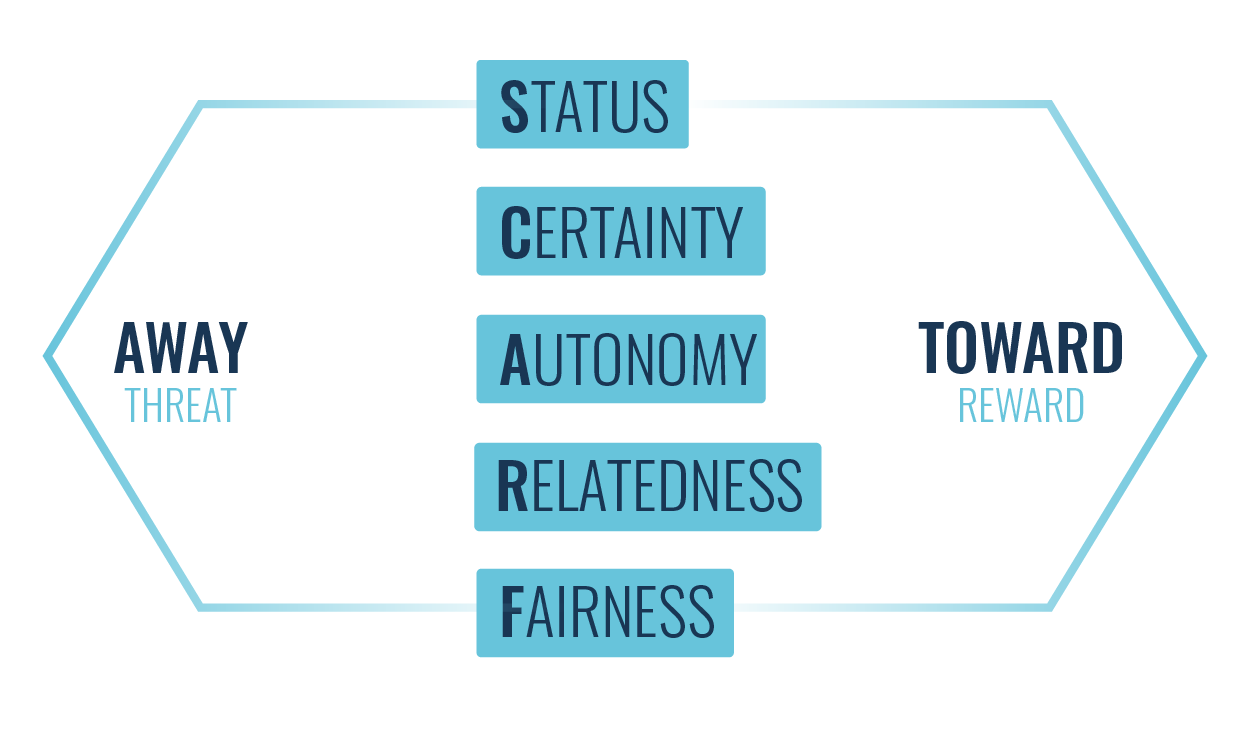
From a neuroscience perspective, clarity helps create certainty, and certainty matters to the brain.
Our brains are constantly scanning our environment for potential threats. When expectations are unclear or situations are ambiguous, uncertainty can trigger a threat response. As this response increases, more cognitive resources become focused on detecting and responding to potential risks, leaving fewer resources available for higher-order thinking.
This can reduce our ability to concentrate, think flexibly, solve problems and make effective decisions.
As a result, people are more likely to:
- Overthink decisions.
- Delay taking action.
- Avoid difficult conversations.
- Make more mistakes.
- Communicate less effectively.
- Withdraw rather than contribute ideas.
Conversely, when expectations are clear, the brain experiences greater certainty. This allows more cognitive resources to be directed towards attention, planning, creativity, learning and problem-solving—the very skills people need to perform at their best.
How do you know if your team needs greater role clarity?
Some common signs include:
- The same questions keep being asked.
- Work gets duplicated.
- Tasks are forgotten.
- Team members say, “I thought someone else was doing it.”
- Accountability conversations become difficult.
- People avoid making decisions because they are unsure who is responsible.
- Team members become frustrated with one another.
If several of these sound familiar, it may be time to revisit roles and responsibilities with your team.
How can leaders create greater role clarity?
Creating role clarity isn’t about producing longer job descriptions. It’s about having regular conversations that create shared understanding.
Here are five practical ways to improve role clarity.
1. Define responsibilities together
Rather than handing someone a job description and assuming it is understood, discuss responsibilities together and explore what they look like in practice.
2. Agree what success looks like
Clarify what good performance looks like, how success will be measured and what outcomes are expected.
3. Clarify decision-making
Be clear about which decisions people can make independently and when they should seek support or escalate an issue.
4. Remove overlap
Where responsibilities overlap, agree who has ownership to reduce duplication and confusion.
5. Review regularly
Roles naturally evolve as organisations grow and priorities change. Regular one-to-one conversations help ensure expectations remain clear.
Leaders can further support role clarity by:
- Setting clear expectations rather than assuming people understand them.
- Providing regular, constructive feedback.
- Encouraging questions and open communication.
- Reviewing and updating responsibilities as roles evolve.
Why role clarity matters at the start of your leadership journey
Creating role clarity early establishes the expectations, boundaries and behaviours that underpin a high-performing team.
It is much easier to build clarity from the beginning than it is to unpick months of confusion, assumptions and frustration later.
Role clarity also forms the foundation of accountability. People cannot be accountable for responsibilities that have never been clearly discussed or agreed.
When people understand what is expected of them, why their work matters and how success will be measured, accountability becomes fairer, performance improves and difficult conversations become less frequent.
For new leaders, investing time in creating role clarity is one of the most valuable things you can do. It builds stronger habits, healthier team relationships and creates an environment where people can perform with confidence.
Because before people can be held accountable, they first need clarity.
Ready to Create More Clarity in Your Team?
Role clarity is one of the foundations of effective leadership. When people understand what they’re responsible for, what success looks like and how their role contributes to the wider team, they’re more likely to perform well, communicate effectively and take ownership of their work.
If you’re a new leader, or you’re growing a team within your business, creating that clarity from the start can save months of confusion, frustration and difficult conversations later on.
Our Leadership & Role Clarity module is designed to help you do exactly that. You’ll learn practical, neuroscience-informed strategies to:
- Define clear roles and responsibilities.
- Set expectations that your team understands.
- Build accountability through shared clarity.
- Increase confidence, performance and engagement.
- Create strong foundations for a high-performing team.
Whether you’re leading your first employee or building a growing team, this module will give you the tools and confidence to lead with greater clarity.
References:
- Abraham, K. M., Erickson, P. S., Sata, M. J., & Lewis, S. B. (2022). Job satisfaction and burnout among peer support specialists: the contributions of supervisory mentorship, recovery-oriented workplaces, and role clarity. Advances in Mental Health, 20(1), 38–50. https://doi.org/10.1080/18387357.2021.1977667
- Bernuzzi, C., Sommovigo, V., Maffoni, M., Setti, I., & Argentero, P. (2023). A Mixed-method Study on the Bright Side of Organizational Change: Role Clarity and Supervisor Support as Resources for Employees’ Resilience. Journal of Change Management, 23(2), 143–176. https://doi.org/10.1080/14697017.2023.2172057
- Fang, C., Ran, Y., Huan, Z. et al. The mediating role of decent work perception in role clarity and job embeddedness among Chinese nurses: a cross-sectional study. BMC Nurs 24, 225 (2025). https://doi.org/10.1186/s12912-025-02861-z
- Francis, Twinamasiko Clarifying Roles, Enhancing Results: Job Descriptions and Employee Performance, 2025, East African Journal of Business and Economics,C Volume 8, Issue 2, DOI:10.37284/eajbe.8.2.3312
- Gargi Sawhney, Mallory A. McCord, Austin Cunningham, Peter Cook, Kwesi Adjei, Taylor Flinn, A meta-analytic review of 60 years of role stressor research, Journal of Vocational Behavior, Volume 167, 2026, 104234, ISSN 0001-8791, https://doi.org/10.1016/j.jvb.2026.104234.
- Ganga Kamble, Manikant S Kulkarni, Dr. Veena Ishwarappa Bhavikatti, A Study on Role of Empowerment, Trust, Role Clarity in Teamwork in Employee Productivity , Journal of Science, Architecture, Technology, and Environment, Volume 3, Issue 4, 2026, ISSN 3048-8222.
- Hassan, S. (2013), The Importance of Role Clarification in Workgroups: Effects on Perceived Role Clarity, Work Satisfaction, and Turnover Rates. Public Admin Rev, 73: 716-725. https://doi.org/10.1111/puar.12100
- Kundu SC, Kumar S, Lata K (2020), “Effects of perceived role clarity on innovative work behavior: a multiple mediation model”. RAUSP Management Journal, Vol. 55 No. 4 pp. 457–472, doi: https://doi.org/10.1108/RAUSP-04-2019-0056
- Lan M, Hu Z, Nie T. Unwilling or Unable? The Impact of Role Clarity and Job Competence on Frontline Employees’ Taking Charge Behaviors in Hospitality Industry. Behav Sci (Basel). 2025 Apr 14;15(4):526. doi: 10.3390/bs15040526. PMID: 40282148; PMCID: PMC12024181.
- Newnam S, Stephens A, Muir C, Bruce S, Austin T, et al. (2021) Safety outcomes for incident responders operating on high speed roads: An analysis of the relationship with behaviour, motivation and role clarity. PLOS ONE 16(3): e0247095. https://doi.org/10.1371/journal.pone.0247095
- Orgambídez A, Almeida H. Social support, role clarity and job satisfaction: a successful combination for nurses. Int Nurs Rev. 2020 Sep;67(3):380-386. doi: 10.1111/inr.12591. Epub 2020 May 20. PMID: 32436283.
- Van Dongen D, Guldenmund F, Grossmann I, Groeneweg J. Classification of influencing factors of speaking-up behaviour in hospitals: a systematic review. BMC Health Serv Res. 2024 Dec 28;24(1):1657. doi: 10.1186/s12913-024-12138-x. PMID: 39732664; PMCID: PMC11681692.
- https://www.gallup.com/workplace/648500/employee-wellbeing-hinges-management-not-work-mode.aspx