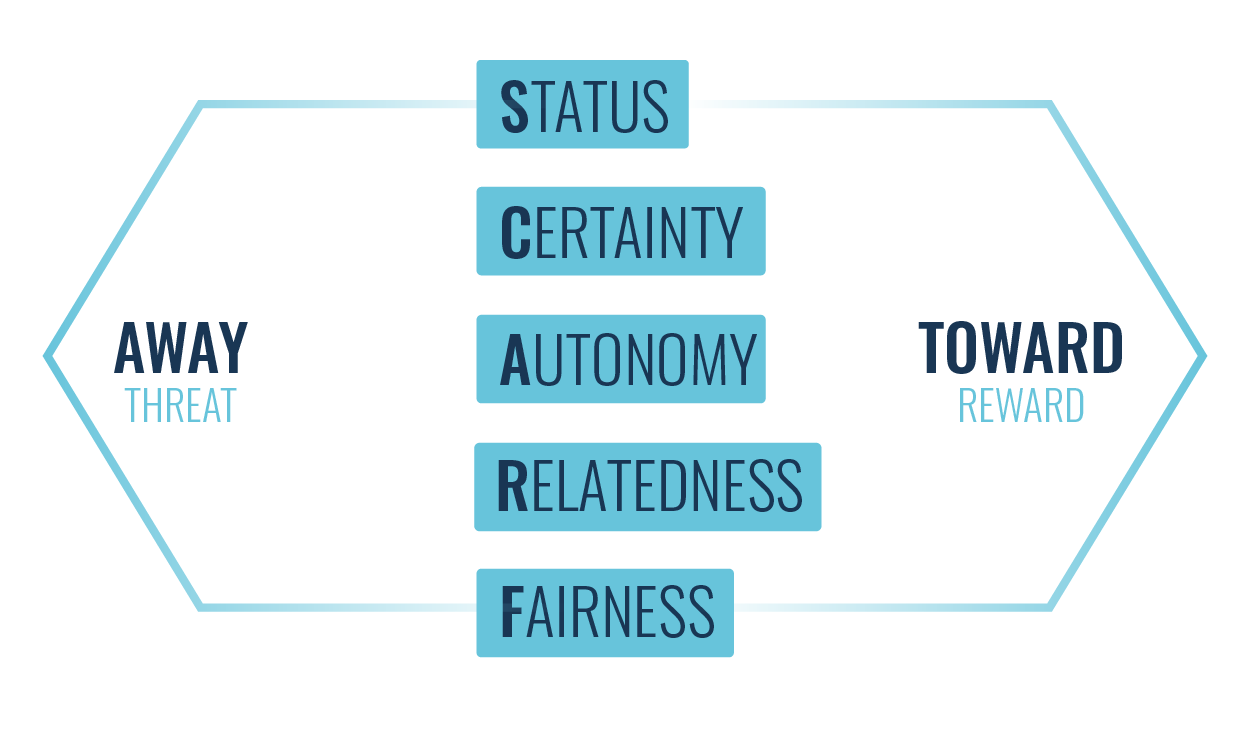
Our brains naturally seek reward and avoid threat. Humans, being social creatures respond in the same way to social threats as we do to physical threats to life. Fear of being judged, blamed, or dismissed can light up the same stress pathways as physical danger. When the brain perceives a threats, the brain’s limbic system triggers stress responses that impairs thinking, creativity, and connection. However, when needs are met with reward signals, the brain releases dopamine and oxytocin, which enhance motivation, trust, and resilience.
The SCARF model identifies five domains that influence whether a situation triggers threat or reward:
- Status: Our relative importance or standing in a group
- Certainty: Our ability to predict what will happen
- Autonomy: Our sense of control over events
- Relatedness: Our feeling of safety with others, trust and connection
- Fairness: Our perception that exchanges and decisions are just
Recognition, transparency, empowerment, connection, and equity in these domains all send reward signals to the brain that open minds and hearts.
Applying SCARF to Create Emotional Safety in Your Leadership
Here are clear steps founders, CEOs, and leaders can take to use SCARF as a roadmap for emotional safety and sustainable leadership:
1. Honour Status with Respectful Recognition
- Recognise achievements publicly and authentically—small wins matter for brain reward.
- Provide specific, constructive feedback privately when improvement is needed to avoid triggering threat.
- Avoid public comparisons or criticism, which can feel threatening and damage trust.
- Encourage peer-to-peer recognition to build mutual respect throughout your team.
2. Create Certainty Through Transparent Communication
- Share clear, timely updates on strategy, decisions, and changes. Uncertainty is one of the biggest stressors.
- Break down complex information into understandable, actionable steps.
- Establish consistent routines and clear expectations so your team can anticipate what’s next.
- When change is necessary, openly acknowledge what’s unknown and how you’ll navigate it.
3. Promote Autonomy by Empowering Choice and Control
- Set clear goals but grant freedom in how people achieve them to foster ownership.
- Avoid micromanaging; instead, coach and guide.
- Offer options where possible to improve personal agency.
- Encourage initiative-taking and diverse working styles—no one-size-fits-all.
4. Build Relatedness with Genuine Connection and Trust
- Invest time in building relationships beyond tasks—this fosters oxytocin-driven safety.
- Create safe spaces for honest dialogue and vulnerability by modeling it yourself.
- Avoid blame or judgment, especially when things go wrong. Use mistakes as learning opportunities.
- Foster inclusivity and celebrate diversity as strengths.
5. Ensure Fairness by Leading with Transparency and Equity
- Make decision-making processes visible and consistent.
- Address potential biases and ensure equitable treatment for all team members.
- Invite feedback and open dialogue about fairness concerns to correct course.
- Align policies and rewards with your organizational values to reinforce fairness.
Why Emotional Safety Matters for Sustainable Leadership and Your Business
Creating psychological safety is not soft or optional leadership; it’s a business imperative with measurable benefits:
- Boosts innovation: People are more willing to share creative ideas and experiment when they feel safe.
- Improves engagement: A reward-driven brain means motivation is sustainable and burnout reduces.
- Enhances resilience: Teams recover faster from setbacks when trust and fairness are strong.
- Supports retention: Employees stay longer where they feel respected and valued authentically.
Building emotional safety aligns your leadership behaviour with your culture and vision, creating an environment where people thrive.
How to Begin Your SCARF-Informed Leadership Journey
- Start with self-awareness: Notice when you or your team feels threatened or rewarded in each SCARF domain.
- Use regular check-ins and feedback sessions to learn about others’ needs and experiences.
- Introduce SCARF language in team meetings to foster shared understanding and psychological safety awareness.
- Consider bringing in expert-led workshops or coaching to embed these principles deeper into your leadership culture.
Take Action: Build Trust, Emotional Safety, and Sustainable Performance
Your leadership sets the tone for what your organization values. By proactively using the SCARF model to reduce threat and amplify reward in emotional safety domains, you’re investing in a culture where your people feel deeply seen, heard, and empowered.
If you want to integrate these brain-based leadership strategies with tailored support, workshops, or consultations to drive lasting change, let’s connect. Together, we can build the psychologically safe, high-performing culture that your vision deserves.